
Modern consumers expect more than just good products; they crave experiences that feel personal and intuitive. As expectations soar, marketing is undergoing a major shift. According to Cisco’s 2025 research, 92% of organizations now believe delivering exceptional customer experiences is more crucial than ever.
At the heart of this transformation lies the convergence of Agentic AI, an autonomous system that plans, executes, and optimizes campaigns, and hyper-personalization, which uses real-time data to tailor experiences to the individual. Together, they are redefining how brands connect with customers, enabling scalable, intelligent engagement like never before.
Let’s explore how the fusion of Agentic AI and hyper-personalization is revolutionizing modern marketing and why this powerful combination is essential for staying ahead in a rapidly evolving landscape.
Key Takeaways
- The global agentic AI market is projected to grow from $6.67 billion in 2024 to over $10 billion in 2025, with adoption expected to reach 86% of companies by 2027, signaling mainstream integration in marketing and beyond.
- Hyper-personalization powered by AI and real-time data analytics delivers highly tailored customer experiences, boosting engagement and loyalty through dynamic content and contextual messaging.
- Combining agentic AI with hyper-personalization enables marketers to autonomously create and optimize millions of personalized campaigns at scale, significantly improving efficiency, ROI, and customer satisfaction.
What is Agentic AI?
Agentic AI refers to autonomous AI systems capable of independently planning, executing, and optimizing tasks with minimal human input. Unlike traditional AI tools that assist with isolated functions, agentic AI proactively manages end-to-end workflows. It acts with intent, making decisions based on real-time data to achieve defined objectives, essentially functioning as a virtual marketing manager.
These systems can perform tasks such as content creation, bid adjustments, A/B testing, and customer segmentation, all without manual intervention. They continuously learn and adapt, making them more effective over time.
Why Agentic AI Matters for Marketing
Agentic AI is rapidly transforming the marketing landscape by taking automation to the next level. Market forecasts predict its value will surge from $6.67 billion in 2024 to $10.41 billion in 2025, representing a CAGR of 56.1%. By 2027, 86% of companies are expected to have agentic AI agents operational, signaling its shift from a niche technology to a mainstream enterprise tool.
This growth is fueled by its ability to automate up to 50% of business workloads, especially in service-driven sectors like customer support, marketing, and IT. Gartner even projects that by 2029, agentic AI will autonomously resolve 80% of common customer service issues, reducing costs by 30%.
For marketers, this means more time to focus on strategy and creativity, while the AI handles execution, optimization, and performance monitoring all in real time.
Understanding Hyper-Personalization
Hyper-personalization is an advanced marketing approach that surpasses traditional segmentation by leveraging AI, real-time data, and analytics to deliver highly tailored customer experiences. It uses granular data points such as browsing behavior, location, purchase history, and contextual factors to customize messaging, offers, and interactions uniquely for each individual.
Examples include:
- Dynamic ads that adapt content based on user behavior
- Personalized landing pages tailored to visitor interests
- AI-driven recommendation engines suggest relevant products
- Chatbots providing context-aware customer support
This approach significantly boosts customer engagement, satisfaction, and loyalty by making marketing communications feel relevant and timely. Businesses are increasingly adopting data analytics to improve customer experience and retention in this personalized landscape.
How Agentic AI Enables Hyper-Personalization at Scale
Agentic AI supercharges hyper-personalization by autonomously creating and managing thousands, even millions, of personalized content variations simultaneously. It continuously learns from customer interactions, adjusting messaging, timing, and channels in real-time to optimize campaign effectiveness.
Key benefits include:
- Scalability: Agentic AI can deliver individualized experiences for millions without increasing human resources, overcoming traditional personalization bottlenecks.
- Closed Feedback Loop: Real-time data from customer interactions feeds back into the AI system, enabling continuous campaign refinement.
- Efficiency: Automation of repetitive tasks frees marketers to focus on strategic initiatives.
Real-world success stories illustrate this impact. For instance, Spotify’s personalized recommendations leverage agentic AI to tailor music suggestions dynamically, enhancing user engagement. Similarly, HMV reported significant revenue lifts through autonomous marketing campaigns driven by agentic AI.
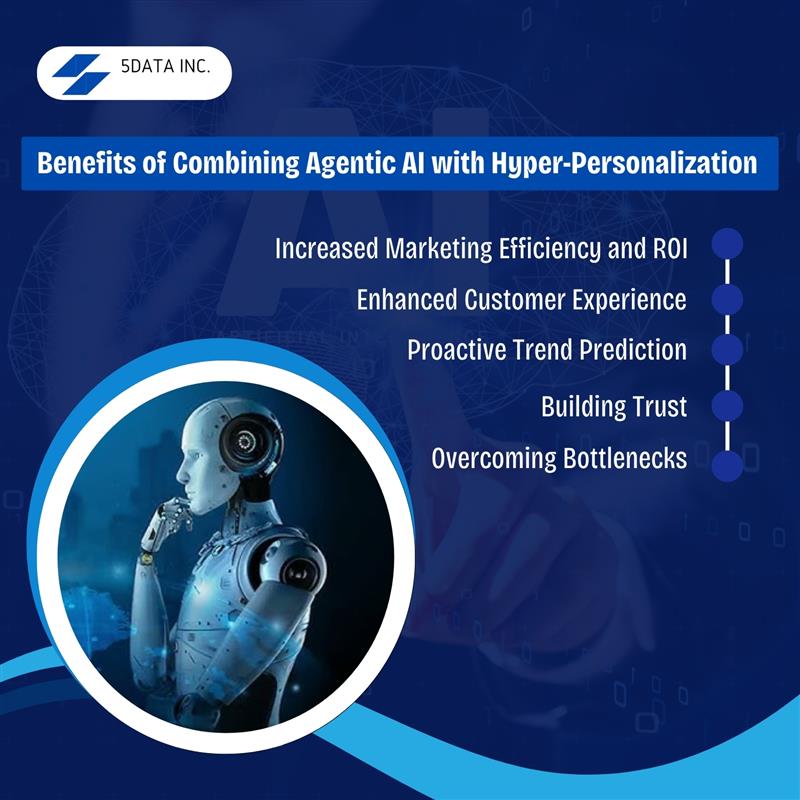
Benefits of Combining Agentic AI with Hyper-Personalization
- Increased Marketing Efficiency and ROI: Automation and intelligent optimization reduce manual workloads and improve campaign performance. About 62% of businesses expect agentic AI to deliver over 100% ROI, with an average return of 171%.
- Enhanced Customer Experience: Customers receive relevant, timely, and context-aware communications, fostering deeper connections and loyalty.
- Proactive Trend Prediction: Agentic AI analyzes vast datasets to anticipate customer needs and market shifts ahead of competitors.
- Building Trust: Personalized marketing that feels empathetic and human-like helps build long-term trust and retention.
- Overcoming Bottlenecks: Scaling personalization and managing complex campaigns becomes manageable, freeing marketers to focus on creativity and strategy.
A perfect example of performance optimization is how businesses are maximizing ROI with data-driven PPC campaigns, a strategy that aligns naturally with the capabilities of Agentic AI.
Challenges and Ethical Considerations
Despite its advantages, agentic AI and hyper-personalization raise privacy and ethical concerns. Extensive data collection can risk customer privacy if not handled transparently and securely. Marketers must balance personalization with data security and maintain clear communication about data usage to preserve trust.
Ethical AI use also requires addressing algorithm bias and ensuring AI decisions are explainable. As agentic AI takes on more responsibilities, marketing teams, not just IT, need training to monitor AI performance and intervene when necessary.
Conclusion
Agentic AI combined with hyper-personalization is ushering in a transformative phase in marketing characterized by autonomous, data-centric, and highly individualized customer interactions. As the agentic AI market is expected to expand swiftly and become widely adopted by 2027, marketers need to integrate these innovations to remain competitive and address consumers’ changing needs.
The future promises continuous innovation and a blended human-AI workforce where creativity, ethics, and strategy are augmented by autonomous AI agents delivering unparalleled customer experiences.
FAQs
1. What is agentic AI in marketing?
Agentic AI is an autonomous AI system that independently plans, executes, and optimizes marketing campaigns by analyzing data and making real-time decisions with minimal human intervention.
2. How does hyper-personalization differ from traditional personalization?
Hyper-personalization uses AI and real-time analytics to tailor experiences at an individual level based on granular data points, whereas traditional personalization relies on broader segments and static rules.
3. What are the main benefits of combining agentic AI with hyper-personalization?
The combination increases marketing efficiency, enhances customer experiences with relevant messaging, enables proactive trend prediction, and helps scale personalized campaigns effectively.