The data fabric—a breakthrough in modern data architecture that connects, integrates, and manages data across disparate sources without physically moving it. Companies worldwide are turning to data fabric solutions to knock down barriers, foster insight-driven cultures, and unleash the full potential of their data assets.
In this blog, we’ll journey through the real-world advantages of data fabric, sharing stories, practical use cases, and up-to-date statistics that illuminate why unified, seamless data integration is the catalyst for next-level business intelligence.
What we cover in this blog
- Key Takeaways
- The Modern Data Dilemma: Drowning in Disparate Information
- Weaving the Data Fabric: What Is It and Why Now?
- Breaking Down Data Silos: The Story of Real Change
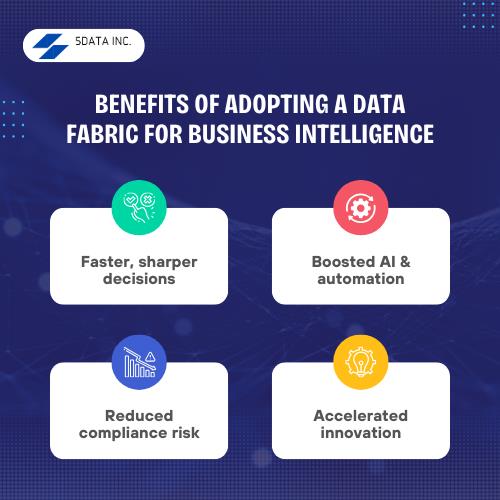
- Benefits of Adopting a Data Fabric for Business Intelligence
- Data Fabric In Action: Use Cases That Matter
- Conclusion: From Silos to Synergy—Your Next Step
Key Takeaways
- Data silos are a major obstacle: 68% of organizations list data silos as their top data challenge, stalling innovation and slowing decision-making.
- Data fabric delivers measurable results: Businesses implementing unified data fabric strategies report up to 55% increased productivity and 50% lower operational costs.
- Unified data powers smarter business: Organizations that break down silos gain real-time insights, support AI initiatives, and position themselves for rapid innovation and compliance.
The Modern Data Dilemma: Drowning in Disparate Information
Imagine a thriving retailer whose sales team logs transactions in an on-premises database. Marketing runs campaigns from a cloud CRM. Inventory is tracked on yet another system, while customer support logs issues in a separate tool. Each department collects valuable data but lives in isolation.
It’s a familiar story with a costly twist. According to the latest reports, businesses worldwide will generate 181 zettabytes of data by 2025, a nearly threefold increase from 2020. Yet, 82% of enterprises admit that data silos still disrupt critical workflows, and more than two-thirds of their data remains unanalyzed.
The costs of fragmented data include:
- Redundant and conflicting records.
- Missed opportunities due to slow reporting.
- Increased compliance and security risks.
- Wasted resources and duplicated efforts.
Data chaos isn’t just a technical hassle; it’s a strategic roadblock. In a marketplace demanding agility and accuracy, siloed data hinders swift responses, sharp insights, and innovative action.
Weaving the Data Fabric: What Is It and Why Now?
So, what’s the magic behind data fabric? At its core, a data fabric is an intelligent data architecture that connects distributed data across cloud, on-prem, and hybrid environments without moving it. It acts as a “virtual fabric,” weaving together information from disparate sources and providing users with unified, secure, and real-time access.
Key features of an enterprise data fabric include:
- Distributed architecture and data virtualization
- Intensive use of metadata for smart data discovery
- Automated data integration, cleansing, and governance
- AI-driven recommendations for faster insights
- Uniform security, privacy, and quality policies
By “knitting together” data wherever it resides, a data fabric offers a single, governed layer for exploration, analytics, and decision-making. No more handcrafting custom integrations or drowning in manual data preparation.
Breaking Down Data Silos: The Story of Real Change
Let’s bring this transformation to life. Take for example, a global investment firm struggling with fragmented data silos spread across business lines and geographies. Siloed data stifled portfolio insights and slowed regulatory compliance.
By implementing a unified data fabric solution:
- Cloud costs fell by 50%
- Operational manpower dropped 35%
Teams gained a centralized, reliable foundation for real-time analytics. Instead of chasing spreadsheets and reconciling conflicting reports, analysts accessed a single source of truth. Business leaders made faster, data-driven decisions, accelerating innovation and growth.
Their story is not unique—such results are mirrored across industries that have adopted data fabric architecture.
Benefits of Adopting a Data Fabric for Business Intelligence
Unified data goes beyond connecting the dots—it’s about revealing the bigger picture and enabling confident, data-driven action. Here are key benefits:
- Faster, sharper decisions: Up-to-the-minute analytics that empower teams to respond to market trends or customer demands in real time.
- Boosted AI and automation: Data fabric enables AI projects, with over 50% of organizations expected to deploy AI initiatives by 2025 relying on unified, high-quality data to succeed.
- Reduced compliance risk: Consistent, end-to-end governance helps ensure regulatory adherence and data security across all sources.
- Accelerated innovation: Self-service access to integrated data fuels new products, services, and market advantages.
Data Fabric In Action: Use Cases That Matter
No matter the industry or scale, the data fabric approach transforms scattered information into actionable knowledge.
- 360° Customer View: Marketing, sales, and service can finally collaborate, creating targeted campaigns and personalized experiences based on all available data sources.
- Operational Efficiency: Manufacturing firms unify supply chain, sales, and machinery data to predict maintenance, reduce downtime, and optimize resources.
- Don’t Regulatory Compliance: Financial and healthcare organizations apply data governance universally, easing audits and supporting privacy mandates.
Conclusion: From Silos to Synergy—Your Next Step
Data fabric isn’t just architecture—it’s a competitive advantage. As data volumes explode and business becomes more complex, organizations need unified, trusted views of their entire ecosystem.
By weaving together disparate systems and empowering people with real-time, high-quality information, data fabric enables you to unlock innovation, drive smarter decisions, and lead in a fast-changing world. Invest in a data fabric strategy and empower your organization to transform complexity into clarity.
FAQs
1. What makes data fabric different from a traditional data warehouse or lake?
A data fabric connects data across all environments in real time, without duplicating it, using advanced metadata and automation. Unlike static warehouses or lakes, it offers dynamic, automated integration, governance, and accessibility.
2. How quickly can organizations see ROI with data fabric?
Businesses have reported up to 50% cost reduction and vastly increased productivity within the first year by reducing manual work, consolidating platforms, and streamlining operations.
3. Is a data fabric solution only for large enterprises?
No. While especially valuable for complex, distributed enterprises, data fabric can benefit organizations of any size needing unified, accessible, and governed data.
4. What technology trends support data fabric adoption?
Rising investments in AI, cloud computing, real-time analytics, and data governance are fueling adoption. More than 50% of organizations are prioritizing data integration for AI and BI initiatives in 2025.