

Recent surveys show that more than three-quarters of Businesses are now using AI, and over 70% have integrated generative AI into at least one area of their business. At the same time, investment in this space surged past $30 billion in 2024, signaling strong belief in its long-term value.
For businesses, this isn’t about hype. It’s about staying competitive in a world where speed, precision, and adaptability define success. So, how exactly is AI-powered analytics reshaping business strategy?
Let’s explore the blog to learn where the impact is most visible, what it takes to win, and what the future holds for AI-powered analytics.
Key Takeaways
- AI-powered analytics has moved from experimentation to the mainstream, but measurable value requires focus and scaling discipline.
- The shift from insight to action and automation is the real differentiator in modern business strategy.
- Success depends as much on data quality, governance, and culture as it does on technology itself.
The New Reality of AI-Powered Analytics
Traditional analytics answered “what happened.” AI analytics goes further, predicting what will happen and, increasingly, what to do about it. With the rise of domain-specific and autonomous “agentic AI,” businesses are moving beyond dashboards to decision-making systems that act in real time.
Adoption is Widespread
- Mainstream usage: Nearly 8 in 10 Businesses report using AI.
- Executive buy-in: More than half of C-suite leaders now use generative AI tools personally, a strong indicator of cultural acceptance.
- Proven results: Controlled studies show developers completing tasks nearly 60% faster with AI assistants, while customer support teams boost productivity by about 15% when equipped with AI copilots.
Why It Matters Now?
Data volumes are exploding, and decision windows are shrinking. Businesses that rely solely on historical reporting risk falling behind. AI provides the ability to adapt strategies in near real-time, helping businesses stay agile in unpredictable markets.
How AI Analytics Is Shaping Business Strategy
Driving Growth and Revenue
- Smarter targeting: Predictive models identify high-potential customers and the best offers to convert them.
- Dynamic pricing: AI tunes prices by channel, demand, and even external factors like weather.
- Personalized experiences: Recommender systems increase sales by suggesting the right product at the right moment.
Example: Walmart used AI-driven route optimization internally, cut costs, and later turned it into a marketable cloud service proving analytics can itself become a revenue stream.
Boosting Operational Efficiency
- Forecasting and inventory: Advanced models balance supply with demand, reducing waste and avoiding stockouts.
- Supply chain resilience: Digital twins allow businesses to simulate disruptions before they happen.
- Process optimization: AI spots bottlenecks and suggests changes that improve throughput without major overhauls.
Speeding Up Decision-Making
Instead of waiting days for reports, managers now rely on AI systems that analyze streaming data and suggest actions instantly, whether that’s rerouting a shipment, reallocating ad spend, or adjusting staffing levels.
Empowering the Workforce
- Analyst copilots: automate tedious reporting, freeing analysts to focus on strategic insights.
- Developer copilots: accelerate coding, giving engineers more time for innovation.
- Customer service AI: drafts replies and surfaces knowledge, making every agent more effective, especially newcomers.
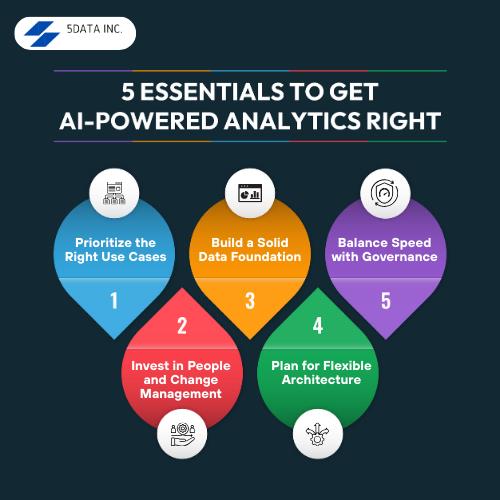
5 Essentials to Get AI-Powered Analytics Right
1. Prioritize the Right Use Cases
Chasing every new tool can drain time and resources. Successful businesses focus on a few high-value, repeatable use cases like lead scoring, churn prediction, or demand forecasting and scale from there.
2. Build a Solid Data Foundation
AI delivers real value only when the data behind it is reliable. For businesses, that means building clean, connected, and accessible data pipelines to get insights that are accurate and on time.
3. Balance Speed with Governance
With rise in AI adoption, risks like bias, data misuse, or faulty automation also increases. To innovate responsibly, businesses need strong governance frameworks such as bias testing, human oversight, and audit trails ensure businesses innovate responsibly.
4. Invest in People and Change Management
AI adoption isn’t just about technology; it’s cultural. Teams need right training, workflow redesign, and clear KPIs to measure real value. Businesses that adopt AI as both a tech and people strategy win faster.
5. Plan for Flexible Architecture
The future points to smaller, domain-specific models and AI agents capable of executing tasks. Businesses must design flexible architectures that integrate these capabilities without driving up cost or complexity.
Conclusion
AI-powered analytics isn’t just changing how businesses make decisions. It’s redefining what business strategy looks like. Leaders who embrace it are already seeing gains in growth, efficiency, and agility. Those who wait risk being left behind in a marketplace where speed and precision are non-negotiable.
Looking ahead, the real winners will be businesses that combine human judgment with AI-driven intelligence, creating businesses that learn, adapt, and execute strategies faster than the competition. The future of business strategy is about having smarter decisions, made in real time.
FAQs
1. How is AI-powered analytics different from traditional analytics?
Traditional analytics explains the past; AI analytics predicts the future and often recommends or automates the best next step.
2. Where should a business start with AI analytics?
Begin with two or three high-impact areas like demand forecasting, customer targeting, or churn prediction and scale only after proving measurable value.
3. Is AI safe to use in industries with strict regulations?
Yes, if deployed responsibly. Clear data governance, bias testing, and human oversight ensure AI is both effective and compliant.