

Data is everywhere, from IoT sensors and CRM tools to support chats, spreadsheets, and yes, even scribbled sticky notes. For enterprise leaders and data teams, this mountain of information brings both opportunity and chaos. We have the tools to store and process all this data, but turning it into meaningful information quickly and on a scale is still a major challenge.
Here’s where Generative AI steps in— not just to speed things up, but to change how we think about data entirely. It’s not just about prediction anymore; it’s about generation, simulation, and empowerment.
This blog takes you through how Generative AI is already being used practically in enterprise settings and how your organization can benefit too.
Key Takeaways
- Generative AI can clean, structure, and synthesize data with minimal manual input, improving efficiency.
- It helps businesses forecast smarter, tailor recommendations, and explore what-if scenarios across different industries.
- With natural language prompts, anyone can explore data. Generative AI empowers all teams, not just data scientists.
The Changing Landscape of Data and Decision-Making
In recent years, we have seen data volumes explode. From structured databases to unstructured sources like audio calls and social media posts, enterprises are sitting on a goldmine of information. Traditional tools and rule-based systems often can’t keep up.
Consider this: your business team needs quick insights, but your data team is bogged down with manual preparation and cleaning. Dashboards take days, and critical decisions get delayed. Sounds familiar?
That’s exactly the kind of problem Generative AI is helping to solve. That’s exactly the gap, Generative AI is starting to fill. Unlike traditional systems that require humans to define rules and pipelines, Generative AI learns patterns, understands context, and generates content. Be it summaries, predictions, or synthetic datasets, this isn’t some far-off dream—it’s already happening.
Real-World Applications of Generative AI in Enterprise Data Analysis
Let’s walk through some practical ways businesses are using Generative AI right now:
1. Automated Data Preparation and Cleaning
Ask any data analyst about their least favorite task, and you’ll likely hear the same thing: data cleaning of mismatched formats, missing entries, and logs—and it’s exhausting.
But Generative AI is changing the game. Think of it as a super-smart assistant that reads unstructured emails, recognizes patterns, fills in the missing information, flags issues, and then hands you a clean, usable dataset ready for analysis. It’s not just automation; it’s intelligent help.
Real-world snapshot:
A global insurance company uses Generative AI to process handwritten claim notes and emails. The model extracts key data points, converts them into structured formats, and reduces manual effort by 60%.
2. Supercharging Predictive and Prescriptive Insights
It’s one thing to forecast future sales. It’s another to ask, “What if I double my marketing budget in Q3?” and get a reliable simulation of outcomes.
Generative AI enables scenario planning that goes far beyond spreadsheets. It generates realistic projections based on hundreds of variables and, more importantly, suggests actionable next steps.
Real-world snapshot:
A retail chain used Generative AI to model different pricing strategies across regions. The system didn’t just say what might happen; it actually recommended price points that would boost the profits without losing customers.
3. Empowering Non-Technical Teams with Generative BI
This one is a game changer. Generative AI lets you talk to your data literally.
Instead of relying on a BI team, a marketing manager can ask, “How did our Q2 digital campaign perform across regions?” The AI responds with a chart, key metrics, and even a short written summary.
Real-world snapshot:
A SaaS company integrated Generative AI into its internal BI platform. Their teams across sales, product, and finance started generating custom dashboards without technical help. Result? Decisions got faster, and dependencies dropped.
4. Generating Synthetic Data for Better Model Training
Sometimes, sensitive data can’t be shared across teams. Other times, there isn’t enough of it to build a robust model. Generative AI helps solve both problems by creating synthetic data that mirrors real patterns without risking privacy.
Real-world snapshot:
A hospital system used Generative AI to generate synthetic patient records for training a diagnosis model. It maintained statistical accuracy while fully protecting patient identities.
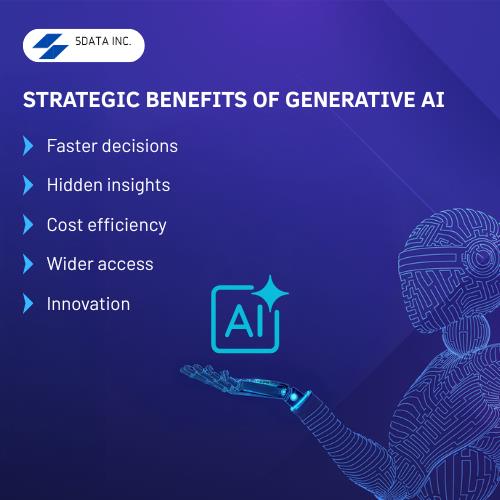
Strategic Benefits of Generative AI
Generative AI isn’t just a tool for automation; it’s a way to make decisions faster, smarter, and more inclusive. Here’s how it adds real value:
- Faster decisions: Time from question to insight shrinks dramatically.
- Hidden insights: Unstructured data like emails, chats, and call transcripts become goldmines.
- Cost efficiency: Less manual labor and dependency on overworked data teams.
- Wider access: Anyone in the organization can interact with data, not just analysts.
- Innovation: With the basics handled, data scientists focus on creative, high-impact projects.
Challenges to Consider
Of course, it’s not all smooth sailing. Like any emerging technology, Generative AI has its share of caveats:
- Data quality and bias: If the input is flawed, the output is flawed.
- AI “hallucinations”: Generative AI can sometimes produce plausible but false outputs; always verify.
- System integration: Don’t expect plug-and-play. It takes planning to integrate with legacy systems.
- Ethics and governance: Be mindful of privacy, compliance, and explainability.
- Skill development: Teams need training to understand and leverage Generative AI effectively.
Step Into the Future
Generative AI is no longer a shiny new buzzword; it’s a workhorse quietly changing how enterprises think about data. From preparing messy logs to simulating future scenarios or making data accessible across departments, its real-world applications are growing fast.
But here’s the key: You don’t have to transform everything overnight. Start small. Pick a use case. Measure impact. Scale thoughtfully. Companies that take that first step today will lead the market tomorrow.
FAQs
1. What is the difference between GenAI and traditional AI in data analysis?
Traditional AI focuses on prediction or classification. Whereas, Generative AI creates new content like summaries, forecasts, or synthetic data based on patterns in the input.
2. Can GenAI replace data analysts or data scientists?
Not at all. It complements them by handling repetitive tasks, allowing experts to focus on strategic work and deeper innovation.
3. How can my company get started with GenAI for data analysis?
Start with one use case like, automated report generation or data cleaning. Ensure your data is in good shape, choose a responsible AI platform, and include a human-in-the-loop for oversight.