
This is where modern data ingestion comes in. The old batch-based methods are being replaced by systems that can handle continuous data from IoT devices, stream it in real-time, and process it instantly. Whether it’s detecting fraud, managing inventory, or responding to customer behavior, this new approach helps businesses make better decisions.
In this blog, we’ll look at how data ingestion is evolving and what that means for the future with some real-world examples, explore the challenges involved, and discuss where things are headed next.
Key Takeaways
- Real-time streaming is essential to ingest and analyze massive data generated by IoT devices.
- AI and edge computing power responsive, autonomous, and cost-effective data ingestion.
- Integrated systems drive predictive operations, hyper-personalization, and enhanced security.
Current Trends in Data Ingestion
From factory floor sensors to everyday fitness trackers, the number of IoT devices is skyrocketing. Each one produces a steady flow of detailed data, and the volume is growing too quickly for old batch-processing methods to manage. To keep pace, industries are embracing real-time streaming ingestion — a technology that captures and processes data the instant it’s created. In sectors like healthcare, manufacturing, aerospace, and retail, this speed isn’t just an advantage; it’s essential.
For example, take hospitals where devices monitor patients’ vitals and send alerts in real time. In factories, equipment data is streamed and analyzed on the go to prevent breakdowns before they happen.
Another big shift is the use of AI and machine learning in these pipelines. These systems can detect issues on the go, adjust data flows, and update models in real time.
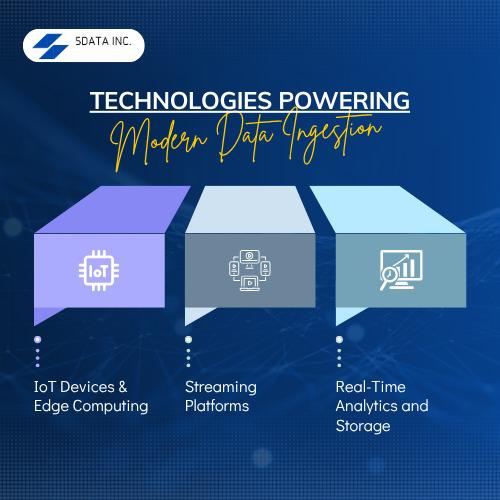
Technologies Powering Modern Data Ingestion
To make real-time ingestion work seamlessly, a stack of integrated technologies is essential that efficiently handles vast streams of data:
- IoT Devices and Edge Computing: Devices generate high-volume, time-series data, often processed locally at the edge to reduce latency and bandwidth use. Edge analytics enable immediate response actions by analyzing data close to its source, transmitting only necessary summaries or anomalies upstream.
- Streaming Platforms: Technologies like Apache Kafka, Apache Flink, and Spark Structured Streaming serve as the transport and processing backbones. These platforms handle real-time ingestion, complex event processing, data enrichment, and scalable distribution.
- Real-Time Analytics and Storage: Processed streams feed into time-series databases (e.g., InfluxDB, TimescaleDB) or real-time analytic databases such as ClickHouse. These support instant querying and support for incremental materialized views to speed up insights generation.
Cloud-native architectures increasingly underpin these systems, employing microservices, Kubernetes orchestration, and serverless computing to handle dynamic scaling and complex workflows cost-effectively.
Challenges in Real-Time Data Ingestion
Despite its promise, integrating IoT, streaming, and real-time processing presents several challenges:
- Scalability and Elasticity: IoT data ingestion traffic is often bursty and unpredictable due to sensor outages or episodic events. Building scalable, elastic architectures that can dynamically handle such fluctuations without overprovisioning remains complex.
- Data Quality and Delays: IoT environments often face delayed or missing data, requiring analytics systems to tolerate incomplete inputs without compromising real-time responsiveness.
- Security and Privacy: Streaming massive volumes of sensitive telemetry data, especially in healthcare and finance, necessitates robust encryption, authentication, and privacy-preserving techniques such as homomorphic encryption or differential privacy.
- Cost Management: Real-time processing can be costly. Businesses must balance the need for speed with economic viability, often opting for near-real-time solutions when appropriate.
Future Opportunities: Where Are We Headed?
The fusion of IoT, streaming, and real-time processing offers numerous opportunities:
- Autonomous Systems: With AI continuously learning from streaming IoT data, systems will become more autonomous and self-healing, requiring less human oversight while improving reliability.
- Hyper-Personalization: Real-time interaction with users will enable instantaneous personalization in retail, entertainment, and digital marketing, transforming customer experiences.
- Predictive Operations: Industries such as manufacturing and logistics will benefit from predictive maintenance and smart supply chains that actively adapt to real-time telemetry, minimizing downtime and optimizing inventory.
- Predictive Operations: Industries such as manufacturing and logistics will benefit from predictive maintenance and smart supply chains that actively adapt to real-time telemetry, minimizing downtime and optimizing inventory.
Real-World Applications in Action
- Healthcare: Edge devices continuously monitor patients’ vitals and trigger alerts in operating rooms, while streaming analytics detect trends to improve treatment plans. Real-time telemetry also supports predictive maintenance of medical equipment.
- Smart Cities: IoT sensors monitor traffic flow, air quality, and energy consumption. Streaming platforms process this data instantly to optimize traffic signals, reduce pollution, and manage utilities efficiently.
- Retail: Smart vending machines and store shelves equipped with sensors automatically track inventory levels. Streaming ingestion feeds these data points into supply chain systems that predict demand and trigger restocking without human intervention.
- Finance: Stock trading algorithms consume real-time news and market data streams to make lightning-fast buy/sell decisions, while fraud detection systems continuously analyze transaction streams to identify suspicious behavior.
Conclusion
The next chapter of data ingestion will be driven by the seamless fusion of IoT, streaming platforms, and real-time analytics. Together, they enable organizations to tap into continuous data flows, making decisions faster and operations more efficient. Challenges around scalability, security, and cost still exist, but rapid progress in AI, edge computing, and cloud-native technologies is paving the way to overcome them.
FAQs
1. What makes real-time data ingestion different from traditional methods?
Real-time ingestion processes and analyzes data continuously as it is generated, minimizing latency compared to batch processing.
2. How do IoT devices impact data ingestion architectures?
They massively increase the volume and velocity of data, necessitating scalable, streaming-based ingestion solutions often complemented by edge computing.
3. What are the challenges in integrating IoT, streaming, and real-time analytics?
Challenges include handling bursty data loads, ensuring data quality despite delays, managing security/privacy, and balancing cost with performance.