

In today’s fast-paced digital economy, customer experience (CX) is a defining factor in business success. Customers expect instant responses, personalized service, and seamless interactions across every touchpoint. Intelligent chatbots have quickly become the first line of communication for many organizations, meeting these rising expectations. But here’s the reality: automation alone cannot always provide the depth of understanding customers seek. Even the most advanced chatbots may falter with complex, nuanced, or emotionally sensitive queries. That’s why the Human-in-the-Loop (HITL) model is gaining momentum.
By combining machine efficiency with human oversight, HITL ensures that interactions remain fast, scalable, and empathetic. As digital transformation accelerates across industries, companies realize that customer service must be both technology-driven and human-centered. HITL intelligent chatbots are redefining CX by ensuring that automation never sacrifices the human touch customers value.
Key Takeaways
- Combining AI chatbots with human oversight delivers faster, more accurate, and emotionally intelligent customer interactions.
- HITL models enable businesses to scale support while navigating complex queries and enhancing personalization.
- Implementing HITL chatbots requires balancing technology and human roles, with best practices that prioritize transparency, training, and data privacy.
The Evolution of Chatbots and the Rise of HITL
Early chatbots were basic, scripted Q&A tools; helpful only when users asked the “right” questions. Conversations that strayed off-script often left customers frustrated. Advancements in natural language processing (NLP), sentiment recognition and contextual understanding, changed the game. Modern chatbots can answer multi-intent questions, track conversation history, and even recognize emotional tone. They’ve evolved into true digital assistants.
Automated systems struggle with ambiguity or emotionally charged situations where empathy and judgment matter most. The HITL approach bridges this gap. When a chatbot reaches its limit due to complexity, compliance, or customer frustration—a human seamlessly takes over. Chatbots stop being replacements and become co-pilots, enriching the overall customer journey.
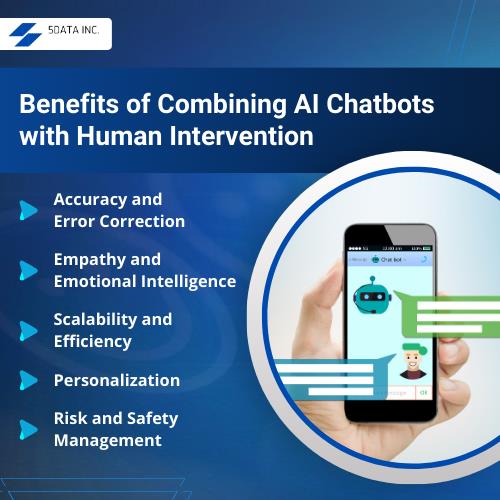
Benefits of Combining AI Chatbots with Human Intervention
The strength of HITL lies in balancing speed with expertise. Key benefits include:
- Accuracy and Error Correction: Human agents refine responses in real time, ensuring context-aware answers.
- Empathy and Emotional Intelligence: While bots can detect tone, only humans provide genuine care and reassurance.
- Scalability and efficiency: Chatbots manage high volumes of routine tasks, freeing humans for complex issues.
- Personalization: Machines suggest tailored solutions, while humans adapt to subtleties bots might miss.
- Risk and Safety Management: Industries like healthcare and finance rely on HITL for compliance, safety, and precision.
This hybrid model doesn’t just resolve queries faster but also it strengthens relationships and boosts loyalty.
Real-World Examples of HITL in Action
- Hunter Apparel Solutions combined automation with human oversight to manage a surge in queries. Results? Response times improved fourfold without compromising quality.
- Customer service platforms now integrate chat assistants into agent dashboards. Bots handle repetitive tasks, while agents step in for nuanced cases, reducing burnout and increasing efficiency.
- E-commerce brands use HITL to automatically escalate difficult cases to human agents, ensuring customers never feel stuck in endless bot loops.
These examples highlight how HITL already drives measurable gains in customer experience and operational performance.
Challenges and Best Practices for Implementing HITL
Adopting HITL requires balance. Businesses must define when to automate and when to involve humans.
Key challenges:
- Deciding escalation points between bot and human.
- Training staff to supervise chatbot interactions.
- Maintaining a consistent tone across channels.
- Addressing data privacy and compliance risks.
Best practices:
- Define clear escalation rules—never leave customers in limbo.
- Train both agents and systems to complement each other.
- Be transparent when users are talking to a bot versus a person.
- Use analytics and feedback to refine continuously.
- Prioritize ethics and compliance, especially in sensitive sectors.
When done right, HITL creates reliable, consistent, and customer-friendly support systems.
Conclusion
Human-in-the-Loop chatbots are reshaping customer service by combining automation’s speed with the empathy of human agents. Far from replacing people, this approach empowers them letting technology handle the routine while humans focus on relationship-building and complex problem-solving.
In today’s competitive landscape, where CX is the ultimate differentiator, HITL isn’t just a tool. It’s a strategic necessity for businesses that want to stay innovative, trustworthy, and customer-first.
FAQs
1. What does Human-in-the-Loop mean in chatbots?
It’s a model where bots manage routine queries, but humans step in for complex or sensitive issues, ensuring accuracy and empathy.
2. How do HITL chatbots improve CX?
They speed up responses with automation while humans provide emotional intelligence and problem-solving for tricky cases.
3. What hurdles do businesses face when implementing HITL?
The main hurdles are defining escalation points, training agents, safeguarding data privacy, and keeping interactions transparent.