

Think about how much data is being created every second from social media interactions and IoT sensors to financial transactions and streaming services. According to IDC, the global datasphere is expected to reach 221 zettabytes by 2026, almost double what it was in 2022. That’s a mind-boggling amount of information, and it’s only going to grow.
As businesses try to make sense of this tsunami of data, the real challenge isn’t just storing it, but it’s building scalable systems that can process, manage, and deliver insights quickly and reliably. Traditional approaches, such as managing separate DevOps, data engineering, and cloud operations teams, are starting to show cracks under this pressure.
This is where platform engineering comes into play.
Platform engineering is the emerging discipline that is transforming how companies build, operate, and scale their data environments. By combining automation, developer-centric tools, robust architecture, and cloud-native technologies, platform engineering is becoming essential for businesses aiming to scale data infrastructure seamlessly. It streamlines workflows, boosts productivity, and ensures consistency without overloading engineering teams.
According to Gartner, by 2026, 80% of software engineering organizations will establish platform engineering teams as internal providers of reusable services and tools.
Let’s dive into the blog to explore how platform engineering is becoming the backbone of scalable, modern data infrastructure and businesses that embrace it are setting themselves up for long-term success.
Key Takeaways
- Platform engineering empowers teams with self-service, automation, and standardization that are critical for scaling data infrastructure.
- Businesses adopting platform engineering are seeing faster time-to-insight and improved reliability across complex data environments.
- With the rise of cloud, AI, and real-time analytics, platform engineering is moving from a nice-to-have to a must-have in modern organizations.
The Rise of Platform Engineering
So, what exactly is platform engineering? In simple terms, it’s the practice of building internal developer platforms (IDPs); custom-built toolkits, workflows, and infrastructure layers designed to give teams everything they need to develop, test, and deploy at scale. Instead of reinventing the wheel for every project, engineers tap into these platforms as ready-made foundations.
Here’s why it’s gaining traction:
- Developer Productivity: Studies show that developers spend up to 40% of their time on non-coding tasks like configuring environments, fixing dependencies, or setting up pipelines. Platforms eliminate this overhead by providing pre-configured, automated workflows. .
- Consistency Across Teams: Standardized platforms reduce “it works on my machine” issues and make it easier to enforce best practices across distributed teams.
- Scalability & Speed: Internal platforms ensure teams can scale infrastructure on demand without manual bottlenecks.
Think of it like Netflix: you don’t build your own streaming service from scratch to watch movies. You use a platform that handles everything behind the scenes. Platform engineering does the same for developers and data engineers
Why It Matters for Scalable Data Infrastructure
Data infrastructure today is more complex than ever. You’ve got cloud-native systems, hybrid environments, real-time data pipelines, and AI workloads all happening simultaneously. Trying to scale that with traditional methods? It’s like trying to run a marathon in flip-flops – it’s possible, but painful.
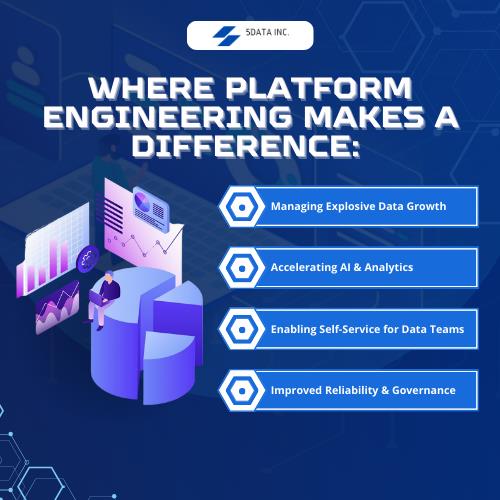
Here’s where platform engineering makes a difference:
1. Managing Explosive Data Growth
With organizations generating terabytes of data daily, scalability isn’t optional. Platform engineering introduces automation and reusable frameworks, enabling teams to scale data lakes, warehouses, and pipelines without constantly reinventing processes.
2. Accelerating AI & Analytics
AI models require massive, clean, and fast-moving data streams. Platform engineering ensures pipelines are optimized for both performance and governance. For instance, companies like Airbnb use internal platforms to streamline machine learning workflows, cutting model deployment time drastically.
3. Enabling Self-Service for Data Teams
Instead of waiting weeks for IT to provision clusters or databases, self-service portals let analysts and data scientists spin up environments on demand without compromising on security or compliance.
4. Improved Reliability & Governance
Platforms bake in security policies, compliance checks, and monitoring from the start. This ensures teams don’t accidentally bypass critical safeguards while still moving fast.
Real-World Examples of Platform Engineering in Action
- Spotify: Built “Backstage,” an internal developer platform that has since become open source. It simplified infrastructure management, service discovery, and documentation for thousands of engineers.
- Airbnb: Uses platform engineering to power its ML infrastructure, making it easier for data scientists to train, test, and deploy models at scale.
- CERN: With massive scientific data pipelines, CERN leverages platform-like systems to orchestrate workloads and optimize compute power across hybrid environments.
These examples highlight that platform engineering isn’t theoretical; it’s actively reshaping how top organizations build and scale their data systems.
The Latest Trends Driving Platform Engineering
- Cloud-Native Everything
With enterprises adopting multi-cloud and hybrid models, platforms offer a unified way to manage infrastructure across AWS, Azure, and GCP without adding complexity. - Shift-Left Security (DevSecOps)
Platforms now integrate security checks early in the pipeline, ensuring compliance and governance are automated instead of an afterthought. - AI-Powered Automation
From predictive scaling to intelligent workload routing, AI is being embedded into platform engineering to further optimize performance. - Rise of Open-Source Platforms
Tools like Backstage, Crossplane, and Kubeflow simply the adoption of platform engineering, enabling organizations to build without starting entirely from scratch.
Key Benefits of Platform Engineering for Data Infrastructure
- Reduced Complexity: Simplifies infrastructure so data engineers can focus on insights, not setup.
- Higher Productivity: Developers reclaim hours lost to repetitive tasks.
- Faster Innovation: With reusable components, teams can experiment and deliver new features more quickly.
- Future-Proofing: Platforms evolve with new technologies, keeping organizations adaptable to market shifts.
Conclusion
As the data landscape continues to expand at breakneck speed, organizations can’t rely on patchwork systems and siloed teams to keep up. Platform engineering provides the blueprint for scalable, reliable, and future-ready data infrastructure by combining automation, consistency, and self-service.
Organizations that invest in platform engineering today are not just solving immediate bottlenecks, they’re laying the foundation for innovation, agility, and long-term growth.
FAQs
What’s the difference between DevOps and platform engineering?
DevOps focuses on bridging development and operations, while platform engineering builds the tools and platforms that make DevOps more efficient. Think of platform engineering as creating the “product” that DevOps teams use.
Is platform engineering only for large enterprises?
No. While enterprises like Spotify and Airbnb pioneered it, mid-sized companies are adopting it too, especially those scaling cloud and data operations quickly.
How does platform engineering support AI and machine learning?
By providing standardized, automated data pipelines and infrastructure, platforms ensure AI teams get reliable, fast access to the datasets and compute resources they need to train and deploy models.