Select Page

Chatbot Accelerators vs Traditional Builds: What You Need to Know 

by | Nov 7, 2025

Recent Blogs

Chatbots have become the frontline of digital customer engagement, transforming how businesses interact with users. From fintech to healthcare and retail, companies are turning to chatbots for faster, smarter, and more personalized support.

As customer interactions grow across digital platforms, managing queries, product questions, and support requests can quickly overwhelm teams. Intelligent chatbots bridge this gap by responding instantly, guiding customers through the sales funnel, scheduling demos, and even assisting in closing deals all without human intervention.

But when it comes to building your chatbot, the real question is should you choose a Chatbot Accelerator, an AI-powered, no-code/low-code platform that enables rapid deployment and automation, or a Traditional Build, a custom-coded, rule-based system offering complete control but requiring more time and resources to develop?

Choosing the right approach depends on your business objectives, scalability requirements, and resources. Let’s explore how both approaches stack up.

Chatbot Accelerators vs Traditional Builds: The Key Differences That Matter

Here’s a breakdown of what truly separates these two approaches:

1. Technology:

  • Accelerators: Built on AI, ML, and NLP, allowing conversational, context-aware interactions.
  • Traditional Builds: Relies on manual coding and predefined scripts effective but rigid.

2. Setup Time:

  • Accelerators: Can be launched in days or weeks using drag-and-drop interfaces.
  • Traditional Builds: Requires months of development and testing before deployment.

3. Scalability:

  • Accelerators: Easily scalable using pre-built AI modules and cloud-based tools.
  • Traditional Builds: Scaling demands additional coding, testing, and infrastructure.

4. Personalization:

  • Accelerators: Delivers real-time, AI-driven personalization based on user behavior and tone.
  • Traditional Builds: Offers static, rule-based responses that need manual updates.

5. Integration:

  • Accelerators: Plug-and-play integration with CRMs, ERPs, and APIs—minimal coding needed.
  • Traditional Builds: Requires custom APIs and developer support for integration.

6. Maintenance & Learning:

  • Accelerators: Continuously learns and updates automatically using AI feedback loops.
  • Traditional Builds: Needs manual maintenance and version updates.

7. Cost:

  • Accelerators: Lower upfront investment and faster ROI.
  • Traditional Builds: High cost of development and upkeep.

Chatbot accelerators are agile, scalable, and cost-effective, ideal for businesses that value speed and automation. Traditional builds, on the other hand, suit businesses that require deep customization, advanced logic, or strict compliance standards.

What’s Trending: The Future of Chatbots Is Smarter Than Ever

The chatbot industry is growing at lightning speed. The global market is all about intelligent automation, personalization, and connected experiences. Here’s what’s shaping the chatbot landscape right now:

  • AI-Powered Personalization: Chatbots are now intuitive. They understand context, user intent, and preferences for human-like responses.
  • Multi-Channel & Multilingual Experiences: From WhatsApp and Messenger to Slack and voice assistants, bots now connect with users wherever they are, often in multiple languages.
  • Generative AI Conversations: Generative AI enables chatbots to craft dynamic, context-aware dialogues, cutting response times by up to 80%.
  • Hyper-Automation: Modern businesses combine RPA (Robotic Process Automation) and chatbots to automate repetitive workflows like lead qualification, order tracking, or ticket routing.
  • Operational Efficiency: Companies using chatbot accelerators report up to 40% lower support costs and improved CX metrics.

Chatbots are no longer simple helpdesk tools; they’re strategic growth enablers driving business intelligence, automation, and brand loyalty.
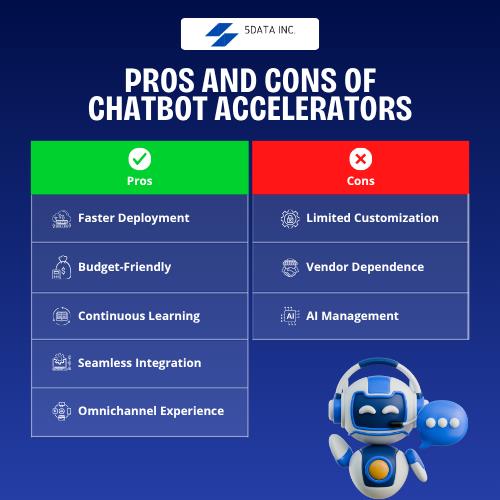
Pros and Cons of Chatbot Accelerator

Real-World Impact: Pros and Cons You Should Know

Chatbot Accelerators

Pros:

  • Faster Deployment: Build and launch bots in days, not months.
  • Budget-Friendly: No large coding teams or heavy infrastructure needed.
  • Continuous Learning: AI improves accuracy and engagement over time.
  • Seamless Integration: Works across CRMs, ERPs, and CMS platforms effortlessly.
  • Omnichannel Experience: Engage customers 24/7 on every channel.

Cons:

  • Limited Customization: Not ideal for highly specific industry use cases.
  • Vendor Dependence: Relies on platform providers for updates and data handling.
  • AI Management: Requires training to fine-tune performance and maintain context.

Traditional Builds

Pros:

  • Total Customization: Full control over logic, tone, and conversational flow.
  • Data Ownership: Complete authority over storage, security, and compliance.
  • Handles Complex Scenarios: Perfect for regulated industries with specific workflows.

Cons:

  • Long Development Time: Can take months to code, test, and deploy.
  • Higher Costs: Demands dedicated developers and ongoing maintenance.
  • Difficult to Scale: Adding new features often means rebuilding from scratch.

Key Takeaways

  1. Chatbot accelerators deliver agility, scalability, and cost-efficiency for growing businesses.
  2. Traditional builds offer full control and customization but require time and technical expertise.
  3. The future belongs to AI-powered hybrid models—flexible, intelligent, and customer-centric.

Bottom line

Customers expect instant, intelligent, and intuitive engagement. If your business values speed, flexibility, and scalability, chatbot accelerators are your best bet. For businesses needing deep customization or compliance control, traditional builds still hold ground.

However, the future lies in hybrid chatbot strategies combining the power of accelerators with the customization of traditional builds.

5DataInc helps businesses leverage AI-driven hybrid chatbot solutions that transform engagement, streamline support, and drive measurable results.