What Is Native App Development?
Native app development involves building applications specifically for a single operating system.
- iOS apps use Swift or Objective-C
- Android apps use Kotlin or Java
Because native apps are developed directly for the platform, they offer deep hardware integration and optimized performance.
Advantages of Native App Development
- High-performance mobile apps
- Smooth animations and platform-native transitions
- Advanced app performance optimization
- Strong security for enterprise mobile applications
- Immediate compatibility with OS updates
Best Use Cases for Native Development
- Fintech and banking apps
- High-performance gaming platforms
- AI-driven and AR/VR applications
- Enterprise mobile applications with complex integrations
If your app requires premium responsiveness and advanced device capabilities, native development often provides the strongest foundation.
What Is Cross-Platform App Development?
Cross-platform app development enables businesses to build a single application and deploy it across multiple platforms using a shared codebase.
Popular frameworks in 2026 include:
- Flutter app development
- React Native development
- .NET MAUI
- Kotlin Multiplatform
This approach significantly reduces development duplication while maintaining functional consistency.
Advantages of Cross-Platform App Development
- Lower cost of app development
- Faster MVP app development
- Shorter time-to-market
- Simplified maintenance
- Simultaneous feature updates across platforms
Modern frameworks like Flutter have dramatically improved rendering performance and UI flexibility, narrowing the gap with native apps.
Best Use Cases for Cross-Platform Development
- Startup MVP launches
- E-commerce applications
- Service-based mobile platforms
- Businesses validating product-market fit
If speed, cost-efficiency, and rapid iteration are priorities, cross-platform development may be the ideal solution.
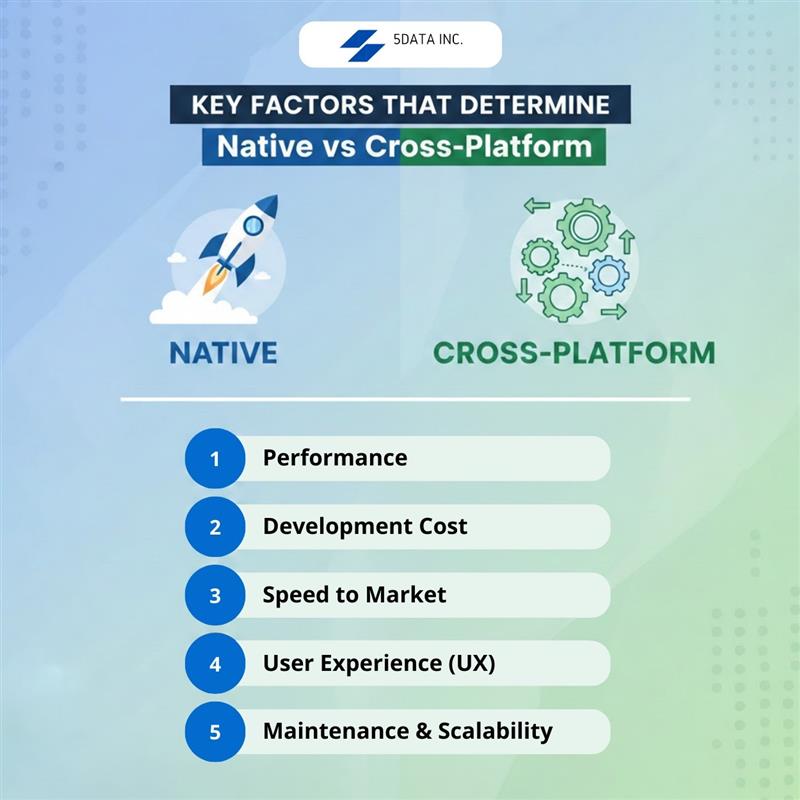
Native vs Cross-Platform App Development: Key Comparison Factors
Mobile technology continues to evolve, but the core decision between native vs cross-platform app development remains critical. Let’s examine the major decision factors.
1. Performance Requirements
- Native apps interact directly with the operating system, delivering superior speed and responsiveness.
- Cross-platform apps perform exceptionally well for most use cases, but for highly complex or performance-intensive applications, native apps still maintain an advantage.
Winner: Native (for performance-intensive applications)
2. Development Cost Considerations
- Native development typically requires separate teams for iOS and Android.
- Cross-platform development enables a single codebase to serve both platforms, reducing overall development costs.
Winner: Cross-platform (for cost efficiency)
3. Time-to-Market Goals
- If launching quickly is a priority, especially for MVP app development, cross-platform frameworks significantly reduce development cycles.
Winner: Cross-platform (for faster deployment)
4. User Experience (UX) Expectations
- Native apps naturally follow platform-specific design guidelines, creating a more familiar and polished user experience.
- Cross-platform apps can deliver a strong UX but may require additional customization to achieve a truly native feel.
Winner: Native (for premium UX control)
5. Maintenance & Scalability
Scalability depends more on strong architecture planning than on the framework alone.
- Native apps gain immediate access to new OS updates and device features.
- Cross-platform frameworks may take time to support new capabilities but simplify maintenance through a shared codebase.
Winner: Depends on your long-term growth strategy