Recent BlogsWhat we cover in this blog When the Pilot Works but Production Doesn't Reason 1: The Data Wasn't...

Recent BlogsWhat we cover in this blog When the Pilot Works but Production Doesn't Reason 1: The Data Wasn't...
Recent BlogsWhat we cover in this blog When the Bots All Break at Once What RPA Was Built For — and Where It...
Building a mobile app in 2026 isn't just about launching on iOS and Android; it's about delivering...
If your digital growth has slowed, the problem may not be your campaigns; it may be how your marketing team is built.
In 2026, digital success is increasingly shaped by structure, not just execution. As AI transforms optimization, data privacy regulations tighten, and customers expect seamless experiences across every digital touchpoint, the way you organize your marketing engine can either unlock scalable growth or quietly limit performance.
What was once a tactical decision has now become a strategic business imperative: Should you invest in an in-house digital marketing team or partner with a specialized agency? From startups seeking speed and flexibility to enterprises navigating scale and complexity, this question influences cost efficiency, execution velocity, and long-term ROI.
In this blog, we’ll break down the real-world advantages and limitations of in-house teams versus digital marketing agencies, helping you uncover which path fuels sustainable growth, maximizes ROI, and keeps your business competitive in an AI-driven landscape.
In-house digital marketing means building your own team within your organization to plan, execute, and optimize your digital initiatives.
A digital agency is an external partner specializing in marketing services like SEO, PPC, content strategy, web design, and analytics. Agencies often serve multiple clients across industries, bringing diverse experience to the table.
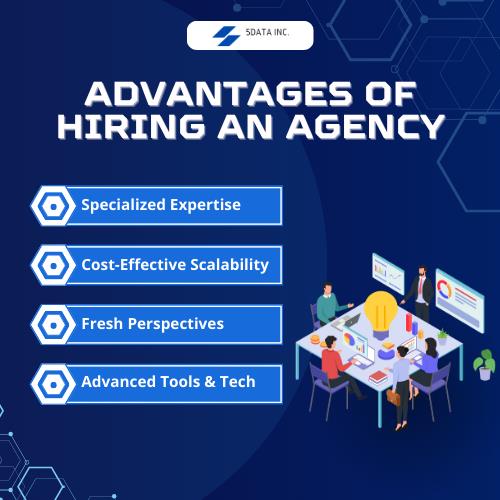
Choosing between in-house and agency depends on compatibility. Here are the key factors to consider:
Early-stage businesses often benefit from agency partnerships, gaining access to talent and tools without heavy upfront investment. Organizations with stable budgets may adopt a hybrid model, combining in-house capabilities with agency specialists.
SEO and content strategy are often best supported by agencies or hybrid teams with deep search expertise. Paid media execution typically works best with agencies that can optimize and scale quickly. Brand messaging is most effective in-house, while analytics and data governance are strongest when owned internally or managed through a hybrid model.
Need fast campaign launches, quick experimentation, or seasonal activations? Agencies can deploy rapidly. But if your roadmap demands continuous iteration and integration across departments, in-house excels.
If your priorities include building proprietary capabilities, developing IP, or strengthening customer relationships over time, investing in in-house expertise is strategic. For tactical execution or short-term projects, agency partnerships are often more efficient.
Many high-growth companies now embrace a hybrid strategy:
🔹 In-House Core Team: Oversees brand strategy, content pillars, data governance, and customer experience.
🔹 Agency Specialists: Provide SEO mastery, paid media insights, web development sprints, and performance optimization.
This model combines brand fidelity with external innovation, maximizing ROI and reducing risk.
There’s no one-size-fits-all answer, but the right choice hinges on your goals, resources, and growth aspirations in 2026. In-house teams offer control and brand depth; agencies bring speed and specialization, and hybrid models deliver balance.
Businesses seeking scalable, data-driven growth increasingly partner with experts like 5DataInc to build future-ready marketing models that balance control, performance, and long-term growth.