Recent BlogsWhat we cover in this blog When the Pilot Works but Production Doesn't Reason 1: The Data Wasn't...

Recent BlogsWhat we cover in this blog When the Pilot Works but Production Doesn't Reason 1: The Data Wasn't...
Recent BlogsWhat we cover in this blog When the Bots All Break at Once What RPA Was Built For — and Where It...
Building a mobile app in 2026 isn't just about launching on iOS and Android; it's about delivering...
As cloud environments grow more complex and multi-cloud adoption becomes the norm, businesses need more than dashboards and reactive monitoring. They need intelligent, adaptive systems capable of understanding workloads, predicting changes, and making decisions at the speed modern infrastructure demands.
AI agents are rapidly emerging as this new layer of cloud intelligence. These agents analyze workloads in real time, detect patterns humans often miss, and take actions that improve performance, strengthen security, and reduce operational costs. This shift is already reshaping industries ranging from e-commerce and fintech to healthcare, manufacturing, and SaaS.
With cloud spending continuing to rise, AI-driven automation becoming a top priority, and ROI pressures intensifying across organizations, integrating AI agents into cloud strategy is becoming essential for long-term competitiveness and operational resilience.
Let’s dive into the blog and learn how AI agents automate cloud operations, boost performance, and improve cost control across complex multi-cloud environments.
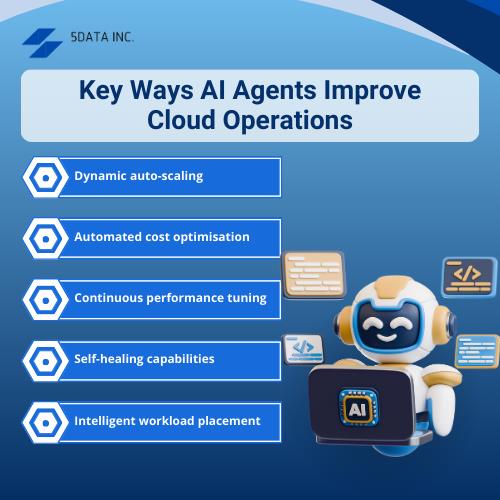
Traditional cloud management relies heavily on engineers reacting to issues, scaling servers, adjusting configurations, reviewing logs, or responding to downtime. AI agents shift this to predictive and autonomous operations, often called AIOps or intelligent cloud automation.
Key ways AI agents improve cloud operations:
For organizations embracing multi-cloud or hybrid cloud architectures, this is a game-changer. Instead of juggling multiple dashboards and configurations, AI agents orchestrate environments holistically, ensuring consistency, efficiency, and resilience.
Cloud-native applications require fast iteration, building, testing, deploying, and updating at scale. AI agents now play a major role throughout the DevOps lifecycle.
How AI-driven DevOps agents transform workflows:
Development teams report faster releases, fewer bottlenecks, and greater confidence in deploying to production. Instead of reacting to failures, they proactively prevent them, a crucial advantage in competitive markets where speed matters.
Cloud security continues to be a major hurdle in shaping an effective cloud strategy. With workloads spread across multiple environments, container-based architectures, and fast-paced deployments, tracking potential threats manually has become increasingly impractical.
AI agents strengthen cloud security posture management (CSPM) by:
This creates a proactive, adaptive security layer, something traditional tools struggle to deliver in dynamic cloud environments. For businesses scaling AI and data workloads, this added protection is invaluable.
Cloud cost management or FinOps has become a major priority for CIOs and CTOs. With dozens of services, regions, and pricing models, manual cost governance is nearly impossible.
AI agents now support or even automate FinOps functions:
This helps organizations maintain cost visibility, reduce waste, and build a financially sustainable cloud strategy, something CFOs now demand as cloud budgets expand.
As companies adopt generative AI, machine learning, and advanced analytics, they need intelligent systems to manage the underlying cloud infrastructure.
AI agents help by:
This makes it easier to launch AI-driven products without overloading existing cloud teams.
Despite their benefits, AI agents require thoughtful adoption.
Key challenges include:
Solving these challenges requires clear cloud governance, transparency, and a phased adoption plan.
AI agents are reshaping cloud strategy in ways that are unimaginable. What started as simple automation scripts has evolved into intelligent systems that manage infrastructure, predict demand, enhance security, and optimize costs with incredible precision.
As cloud environments continue to grow more complex, AI-driven automation will shift from a competitive advantage to a necessity. The next era of the cloud belongs to organizations that harness the power of AI agents and will be better equipped to innovate, control spend, and deliver faster, more reliable digital experiences.