If your digital growth has slowed, the problem may not be your campaigns; it may be how your marketing team...


If your digital growth has slowed, the problem may not be your campaigns; it may be how your marketing team...

A fast-growing retail brand launched a new mobile app just before its biggest festive sale. The UI looked...

Every business today collects data, but not every business knows how to use it effectively. Reports are...
In today’s fast-paced digital world, businesses are under constant pressure to innovate faster, deliver better user experiences, and stay competitive, all while keeping costs under control. Yet, many organizations still struggle with long development cycles, shortage of skilled developers, and complex tech stacks that slow down transformation.
What if there was a smarter way to build powerful applications without getting tangled in endless lines of code or months of backlog? That’s where low-code full stack development comes in.
Let’s dive into the blog to learn how low-code full stack development is reshaping how businesses create, deploy, and scale software at a speed that traditional development can rarely match.
Low-code full stack development combines the speed of low-code platforms (where you can build visually with drag-and-drop tools) with the power of full stack frameworks that cover both the front-end and back-end of an application.
This unified approach allows businesses to develop complete, scalable apps from user interface to database with minimal hand-coding. It empowers IT and business teams to collaborate, experiment, and innovate together.
Leading companies across industries are proving how effective this approach can be.
1. Faster Application Development and Deployment
Low-code platforms reduce development time dramatically. With visual modeling, reusable components, and instant deployment, teams can build applications in weeks instead of months.
For instance, a financial enterprise recently launched a compliance management tool using a low-code full stack platform and reduced its time-to-market by nearly 60%.
2. Greater Agility to Respond to Market Needs
In today’s dynamic market, agility is everything. Businesses can quickly modify workflows, add integrations, and roll out new features to meet customer expectations without rewriting massive amounts of code.
3. Reduced Dependency on Large Developer Teams
Low-code environments automate repetitive coding, allowing small teams to handle large projects efficiently. Even non-developers can contribute to building apps, helping businesses reduce dependency on niche technical expertise.
4. Enhanced Collaboration Between Business and IT
One of the biggest success factors in software delivery is alignment between business goals and IT execution. Low-code full stack platforms bridge that gap, enabling real-time collaboration and faster feedback cycles.
5. Cost Savings and Resource Optimization
By streamlining development and reducing project timelines, low-code full stack platforms deliver measurable cost benefits. They also allow organizations to modernize existing systems without costly overhauls.
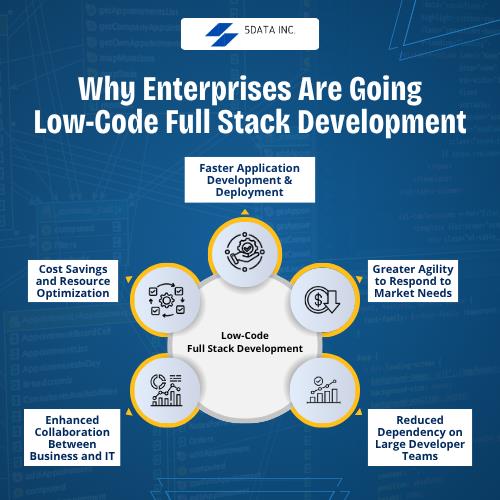
The low-code revolution is not just for small projects anymore; it’s becoming a mainstream enterprise strategy.
These trends are transforming how organizations approach software development from rigid coding cycles to flexible, business-driven innovation.
If your organization is considering this path, start by evaluating a few essentials:
To wrap up, here’s what business should consider:
Low-code full stack development is the future of agile software delivery and digital transformation. By embracing this approach, businesses can build applications faster, stay responsive to market changes, and drive sustainable growth.
Empower your business transformation faster, smarter, and better with 5DataInc. We help organizations unlock this potential with our Full Stack Low-Code Accelerator designed to streamline development, reduce costs, and scale innovation.