If your digital growth has slowed, the problem may not be your campaigns; it may be how your marketing team...


If your digital growth has slowed, the problem may not be your campaigns; it may be how your marketing team...

A fast-growing retail brand launched a new mobile app just before its biggest festive sale. The UI looked...

Every business today collects data, but not every business knows how to use it effectively. Reports are...
A familiar name, Dream11, India’s fantasy sports leader, adopted Flutter to handle millions of users across devices. With one shared codebase, their teams could release updates faster and keep the look and experience identical on every phone. Reported by tech sources in 2023, this move helped Dream11 cut release cycles while keeping performance top-tier.
As more brands scale digitally, they’re realizing that Flutter isn’t just about saving time; it’s about offering consistency, speed, and brand reliability in every digital touchpoint.
In this blog, we’ll explore what makes Flutter so appealing for enterprises, how global brands are adopting it, the challenges they face, and the trends shaping the next wave of cross-platform app development across industries.
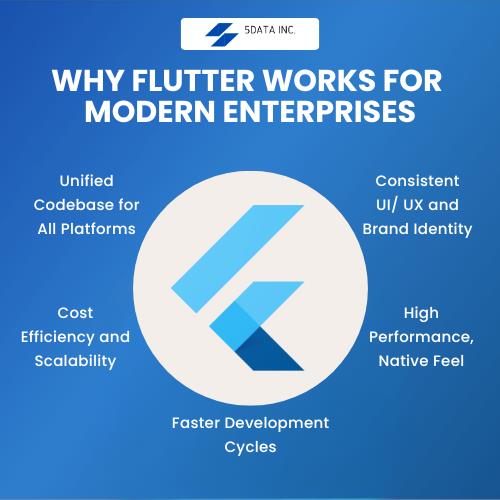
Flutter lets development teams build apps for Android, iOS, web, and even desktop using a single codebase. This drastically reduces duplication, enabling faster rollouts and lower maintenance costs, especially valuable for large teams managing multiple products.
Flutter renders its own interface, so design inconsistencies between operating systems disappear. For enterprises that value brand integrity, that’s a huge win, every button, color, and motion behaves the same.
Flutter compiles directly to native ARM code. The result: apps that open fast, scroll smoothly, and perform as well as native builds. This matters for industries like fintech or logistics, where every millisecond counts.
With features like hot reload, developers see changes instantly. Teams can fix bugs or test UI tweaks in real time helping enterprises push releases quickly and respond to user feedback faster.
Maintaining a single Flutter team instead of two native ones saves both time and budget. It also simplifies scaling, as new platforms (like web or desktop) can be added without rebuilding everything from scratch.
Across sectors, Flutter is helping brands cut costs and ship faster without compromising quality.
Common Architectural Patterns
These methods allow enterprises to maintain strong governance while enjoying the agility Flutter offers.
While Flutter simplifies a lot, large-scale deployments do come with hurdles.
Not every native SDK is fully supported yet.
Workaround: Identify critical integrations early and use custom platform channels to bridge gaps.
Developers used to Swift or Kotlin may need time to adjust to Dart, Flutter’s language.
Workaround: Begin with a pilot project and encourage peer learning across teams.
Cross-platform apps can be heavier or trickier to monitor.
Workaround: Implement automated tests, use Flutter’s tree shaking to trim unused code, and optimize media assets.
Enterprises that plan for these early usually see smoother adoption and long-term ROI.
Flutter’s reach now extends to web and desktop apps, allowing brands to create unified digital ecosystems. For enterprises, this means maintaining one codebase for internal dashboards, customer apps, and web portals.
Companies like Toyota and BMW are experimenting with Flutter in embedded systems and in-vehicle displays. As IoT expands, Flutter’s ability to unify interfaces across hardware and software becomes even more relevant.
Flutter’s ecosystem is evolving rapidly, with better integration into DevOps pipelines and observability tools. Expect to see stronger enterprise governance, improved security libraries, and advanced performance tracking in the coming years.
Enterprises are under pressure to deliver seamless experiences faster than ever. Flutter for Enterprise helps them do that without trading quality for speed. For brands exploring a cross-platform strategy, starting small with a pilot project can reveal just how powerful a unified codebase can be. The era of building once and running everywhere has truly arrived, and Flutter is leading the way.