
Integrated platforms like HMS healthcare management system are leading this transformation by embedding AI and ML capabilities directly into healthcare workflows. With components like HMS patient registration software, healthcare laboratory management, and teleconsultation healthcare software, HMS healthcare management system exemplifies how AI-driven technology is making healthcare smarter, faster, and more personalized.
Let’s dive into the blog to explore how AI and ML are revolutionizing healthcare analytics and why this transformation is defining the future of patient care.
What we cover in this blog
- Key Takeaways
- AI-Driven Diagnostics and Machine Learning Medical Imaging
- AI Predictive Analytics and Electronic Health Records AI Integration
- Automating Healthcare Processes and Reducing Costs
- Healthcare Management System (HMS): AI-Powered Tools Improving Care
- Ongoing Innovations: AI Drug Discovery and Precision Medicine AI
- Benefits of AI and Machine Learning in Healthcare Analytics
Key Takeaways
- AI and machine learning are critical to smarter, faster, and more personalized healthcare in 2025.
- Integrated HMS platforms unlock AI’s full potential across diagnostics, operations, and patient care.
- Breakthroughs in AI-driven drug development and precision medicine are redefining benchmarks with cutting-edge advancements.
AI-Driven Diagnostics and Machine Learning Medical Imaging
One of the most impactful applications of AI in healthcare 2025 is AI-driven diagnostics, which leverage machine learning medical imaging to identify diseases earlier and with greater precision. Advanced algorithms analyze X-rays, MRIs, CT scans, and other imaging data to detect abnormalities that might escape the human eye.
Machine learning models trained on millions of imaging datasets now assist radiologists in spotting cancers, cardiovascular diseases, and neurological conditions. These systems reduce diagnostic errors and accelerate decision-making, enabling quicker treatment starts that improve patient outcomes.
HMS healthcare management system’s clinical services management platform incorporates such AI diagnostic tools, empowering clinicians with real-time insights. This synergy between AI and medical imaging solves key clinical challenges and streamlines diagnostic pathways, making healthcare more proactive.
AI Predictive Analytics and Electronic Health Records AI Integration
AI predictive analytics healthcare tools are revolutionizing how patient data from Electronic Health Records (EHR) is used. Leveraging machine learning on extensive healthcare datasets, these systems predict disease risks, treatment responses, and hospitalization needs.
AI-enabled disease prediction models analyze patient histories, lab results, and lifestyle data for early warnings of conditions like diabetes, heart failure, or sepsis. Integration with EHR AI ensures seamless access to critical data, supporting personalized treatment plans.
Healthcare data analytics machine learning helps identify high-risk patient groups, allowing care teams to intervene sooner. For example, HMS healthcare management system’s HMS patient registration software and healthcare reporting tools facilitate the collection and analysis of real-time data, fueling predictive insights that keep patients healthier and reduce emergency admissions.
Automating Healthcare Processes and Reducing Costs
Efficiency gains from automated healthcare processes AI are transforming hospital workflows. Healthcare Management System (HMS) platforms that automate workflows help minimize administrative tasks, allowing medical professionals to concentrate more on patient care.
Automation of appointment scheduling, inpatient management solutions, and hospital operation theatre scheduling increases throughput.
AI healthcare cost reduction is realized through optimized resource allocation, reduced manual errors, and streamlined healthcare supply chain management.
Intelligent stock management healthcare systems prevent shortages and wastage of critical supplies.
HMS healthcare management system’s open-source healthcare management system and clinical form designer HMS demonstrate how automation enables operational excellence, driving down costs while improving service quality.
Healthcare Management System (HMS): AI-Powered Tools Improving Care
HMS healthcare management system’s comprehensive HMS portfolio illustrates the practical benefits of healthcare AI innovations 2025:
- Clinical services management platform aids clinicians in care coordination and decision support.
- HMS patient registration software accelerates patient intake with AI-enabled identity verification and data validation.
- Healthcare laboratory management uses AI to flag abnormal test results instantly.
- Teleconsultation healthcare software integrates AI triage and symptom-checking tools to enhance remote care.
- Healthcare billing and accounting software automates claims processing with minimal errors.
- Real-time healthcare dashboards offer actionable insights across departments.
- AWS-ready healthcare system deployment ensures scalability and security.
- Multi-language healthcare platforms break down barriers for diverse patient populations.
- Healthcare data security HMS healthcare management system ensures compliance with privacy laws and protects sensitive information.
By embedding AI into every facet of healthcare delivery and management, HMS healthcare management system creates a seamless, intelligent environment for patients and providers alike.
Ongoing Innovations: AI Drug Discovery and Precision Medicine AI
The innovation wave extends beyond diagnostics and operations into treatment itself:
- AI drug discovery 2025 is accelerating the identification of novel therapies by simulating molecular interactions and predicting compound efficacy far faster than traditional labs.
- Precision medicine AI enables tailored treatments based on individual genetic profiles and environmental factors, improving effectiveness and reducing adverse effects.
These advances, driven by healthcare analytics AI and machine learning healthcare applications, hold promise to completely redefine what personalized care looks like.
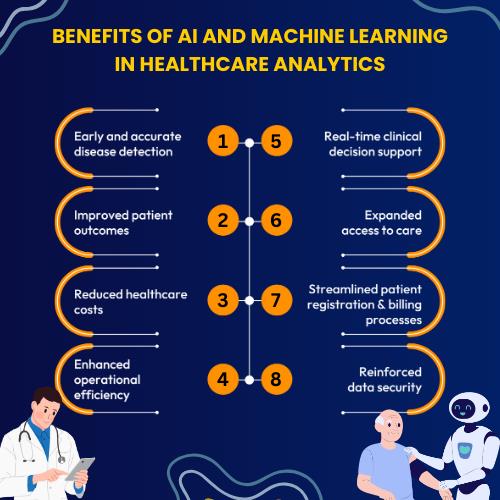
Benefits of AI and Machine Learning in Healthcare Analytics
- Early and accurate disease detection through AI-driven diagnostics.
- Improved patient outcomes via AI-enabled disease prediction and predictive analytics.
- Reduced healthcare costs with automated workflows and supply chain management.
- Enhanced operational efficiency with healthcare workflow automation HMS.
- Healthcare billing and accounting software automates claims processing with minimal errors.
- Real-time clinical decision support improving care quality.
- Expanded access to care through teleconsultation healthcare software.
- Reinforced data security with Healthcare data security HMS healthcare management system solutions. .
Conclusion
Healthcare AI innovations 2025 are ushering in a new era of analytics-driven patient care and operational excellence. Organizations adopting cutting-edge AI platforms like AWS-integrated HMS healthcare systems can boost clinical performance, streamline operations, and drive cost savings. The future of healthcare is intelligent, integrated, and patient-centered powered by AI and machine learning.
FAQs
1. How does AI enhance healthcare data security?
AI-powered HMS platforms use machine learning to detect threats in real time. Encryption and access controls protect patient data and ensure secure, compliant sharing.
2. What are the core challenges in adopting AI healthcare systems?
Major hurdles include data privacy, legacy system integration, and staff resistance. Scalable platforms and proper training help overcome these issues.
3. What new developments are shaping AI-driven decision support in healthcare?
Advancements include intelligent algorithms for tailored treatments, voice-based clinical documentation, AI-powered virtual assistants, and greater transparency to boost trust and wider adoption.